
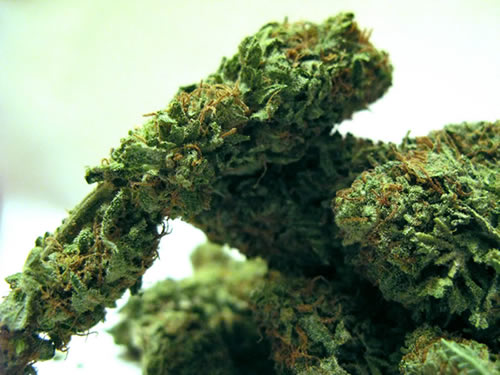
10) MARIJUANA USE HAS NO EFFECT ON MORTALITY: A massive study of California HMO members funded by the National Institute on Drug Abuse (NIDA) found marijuana use caused no significant increase in mortality. Tobacco use was associated with increased risk of death.
Sidney, S et al. Marijuana Use and Mortality. American Journal of Public Health.
Vol. 87 No. 4, April 1997. p. 585-590. Sept. 2002.
Vol. 87 No. 4, April 1997. p. 585-590. Sept. 2002.
9) HEAVY MARIJUANA USE AS A YOUNG ADULT WON’T RUIN YOUR LIFE:
Veterans Affairs scientists looked at whether heavy marijuana use as a
young adult caused long-term problems later, studying identical twins in
which one twin had been a heavy marijuana user for a year or longer but
had stopped at least one month before the study, while the second twin
had used marijuana no more than five times ever. Marijuana use had no
significant impact on physical or mental health care utilization,
health-related quality of life, or current socio-demographic
characteristics.
Eisen SE et al. Does Marijuana Use Have Residual Adverse Effects on
Self-Reported Health Measures, Socio-Demographics or Quality of Life? A
Monozygotic Co-Twin Control Study in Men.
Addiction. Vol. 97 No. 9. p.1083-1086. Sept. 1997
Addiction. Vol. 97 No. 9. p.1083-1086. Sept. 1997
8) THE “GATEWAY EFFECT” MAY BE A MIRAGE: Marijuana is often called a “gateway drug” by supporters of prohibition, who point to statistical “associations” indicating that persons who use marijuana are more likely to eventually try hard drugs than those who never use marijuana – implying that marijuana use somehow causes hard drug use. But a model developed by RAND Corp. researcher Andrew Morral demonstrates that these associations can be explained “without requiring a gateway effect.” More likely, this federally funded study suggests, some people simply have an underlying propensity to try drugs, and start with what’s most readily available.
Morral AR, McCaffrey D and Paddock S. Reassessing the Marijuana Gateway Effect.
Addiction. December 2002. p. 1493-1504.
Addiction. December 2002. p. 1493-1504.
National Research Council. Informing
America’s Policy on Illegal Drugs: What We Don’t Know Keeps Hurting Us.
National Academy Press, 2001. p. 193.
6) PROHIBITION DOESN’T WORK (PART II): DOES PROHIBITION CAUSE THE “GATEWAY EFFECT”?):
U.S. and Dutch researchers, supported in part by NIDA, compared
marijuana users in San Francisco, where non-medical use remains illegal,
to Amsterdam, where adults may possess and purchase small amounts of
marijuana from regulated businesses.
Looking at such parameters as frequency and quantity of use and age at
onset of use, they found no differences except one: Lifetime use of hard
drugs was significantly lower in Amsterdam, with its “tolerant”
marijuana policies. For example, lifetime crack cocaine use was 4.5
times higher in San Francisco than Amsterdam.
Reinarman, C, Cohen, PDA, and Kaal, HL.
The Limited Relevance of Drug Policy: Cannabis in Amsterdam and San
Francisco. American Journal of Public Health. Vol. 94, No. 5. May 2004.
p. 836-842.
5) OOPS, MARIJUANA MAY PREVENT CANCER (PART I):
Federal researchers implanted several types of cancer, including
leukemia and lung cancers, in mice, then treated them with cannabinoids
(unique, active components found in marijuana). THC and other
cannabinoids shrank tumors and increased the mice’s lifespans.
Munson, AE et al. Antineoplastic Activity of Cannabinoids. Journal of the National Cancer Institute. Sept. 1975. p. 597-602.
4) OOPS, MARIJUANA MAY PREVENT CANCER, (PART II): In
a 1994 study the government tried to suppress, federal researchers gave
mice and rats massive doses of THC, looking for cancers or other signs
of toxicity. The rodents given THC lived longer and had fewer cancers,
“in a dose-dependent manner” (i.e. the more THC they got, the fewer
tumors).
NTP Technical Report On The Toxicology
And Carcinogenesis Studies Of 1-Trans- Delta-9-Tetrahydrocannabinol, CAS
No. 1972-08-3, In F344/N Rats And B6C3F Mice, Gavage Studies. See also,
“Medical Marijuana: Unpublished Federal Study Found THC-Treated Rats
Lived Longer, Had Less Cancer,” AIDS Treatment News no. 263, Jan. 17,
1997.
3) OOPS, MARIJUANA MAY PREVENT CANCER (PART III):
Researchers at the Kaiser-Permanente HMO, funded by NIDA, followed
65,000 patients for nearly a decade, comparing cancer rates among
non-smokers, tobacco smokers, and marijuana smokers. Tobacco smokers had
massively higher rates of lung cancer and other cancers. Marijuana
smokers who didn’t also use tobacco had no increase in risk of
tobacco-related cancers or of cancer risk overall. In fact their rates
of lung and most other cancers were slightly lower than non-smokers,
though the difference did not reach statistical significance.
Sidney, S. et al. Marijuana Use and Cancer Incidence (California, United States). Cancer Causes and Control.
Vol. 8. Sept. 1997, p. 722-728.
2) OOPS, MARIJUANA MAY PREVENT CANCER (PART IV):
Donald Tashkin, a UCLA researcher whose work is funded by NIDA, did a
case-control study comparing 1,200 patients with lung, head and neck
cancers to a matched group with no cancer. Even the heaviest marijuana
smokers had no increased risk of cancer, and had somewhat lower cancer
risk than non-smokers (tobacco smokers had a 20-fold increased lung
cancer risk).Vol. 8. Sept. 1997, p. 722-728.
Tashkin D. Marijuana Use and Lung Cancer: Results of a Case-Control Study.
American Thoracic Society International Conference. May 23, 2006.
1) MARIJUANA DOES HAVE MEDICAL VALUE: In response to
passage of California’s medical marijuana law, the White House had the
Institute of Medicine (IOM) review the data on marijuana’s medical
benefits and risks. The IOM concluded, “Nausea, appetite loss, pain and
anxiety are all afflictions of wasting, and all can be mitigated by
marijuana.” While noting potential risks of smoking, the report
acknowledged there is no clear alternative for people suffering from
chronic conditions that might be relieved by smoking marijuana, such as
pain or AIDS wasting. The government’s refusal to acknowledge this
finding caused co-author John A. Benson to tell the New York Times that
the government loves to ignore our report; they would rather it never
happened. (Joy, JE, Watson, SJ, and Benson, JA. Marijuana and Medicine:
Assessing the Science Base.American Thoracic Society International Conference. May 23, 2006.
National Academy Press. 1999. p. 159. See also, Harris, G. FDA Dismisses Medical Benefit From Marijuana.
New York Times. Apr. 21, 2006)
New York Times. Apr. 21, 2006)


No comments:
Post a Comment